HNC Digital Technologies for England - Software Development and Programming
Unlock your potential in the fast‑moving world of software with our HNC Digital Technologies – Software Development and Programming course. This programme offers a broad introduction to digital technologies while exploring the specialist skills that power modern software solutions.
Course still accepting applications for Sept 2026
- Level
- 4
- Entry Point
- Sep 2026
- Duration
- Full Time, 5 months
- Venue
- City College Norwich campus
- UCAS Course Code
- D525
Reasons to study
this course
The HNC Digital Technologies – Software Development and Programming course will develop and strengthens your core skills, while preparing you to study specialist subjects at Level 5 or to enter employment with the qualities necessary for job roles that require some personal responsibility.
You will gain a wide range of knowledge tied to practical skills gained through research, independent study, directed study and workplace scenarios. You will be involved in vocational activities that will help you to develop vocational behaviours (the attitudes and approaches required for a competence) and transferable skills. Transferable skills are those such as communication, teamwork, research and analysis, which are highly valued in higher education and the workplace.
Lincoln Rickwood – Course Leader HNC Digital Technologies for England - Software Development and Programming
Hello, I’m Lincoln, the course lead for HNC Digital Technologies for England - Software Development and Programming. I joined the Higher Education department at City College Norwich in 2024, having spent around forty years working in the digital industries.
During my time in the industries, I worked on the design, development and programming of system and application software, drivers and databases, scientific computing, cryptographic and cybersecurity, network provisioning, product prototyping, and project development.
My work has spanned a variety of fields (academic, financial, industrial, cybersecurity, networking/telco and general IT) and companies ranging from Californian startups to large multinationals in the UK, Europe and the US.
In the process, I have acquired a solid understanding of the industry as a whole, which I now intend to bring to bear in guiding others seeking careers in the digital industries.
If you have questions or enquiries about the course, feel free to email me.
Contact course leaderWhere will this
course take you?
This programme is widely recognised by employers and professional bodies and can provide pathways to both further education and membership of relevant professional bodies.
Course structure
This course is studied full time over two years. The programme is delivered over two days a week - 30 teaching weeks per year.
Level 4 modules
Professional Practice in the Digital Economy Compulsory - Core
This unit provides a foundation for good practice in a variety of contexts and provides an opportunity for you to examine the evolution and impact of digital technologies on work environments. You will explore the importance of professional development for career success and the benefits of working towards goals for career success. In addition, problem solving extends the need to demonstrate transferable and communication skills. Finally, working with others is an integral part of everyday life and the ability to give and receive feedback is a necessary skill to support professional development planning. Therefore, understanding role responsibilities and how to work with peers and colleagues will ensure that there is a better understanding and awareness to support own professional development.
Innovation and Digital Transformation Compulsory - Core
Many businesses manage to remain competitive by using their ability to adapt strategies and re-think their old operating models in response to fundamental changes in the market. Technology gives these organisations the opportunity to evolve and to increase their value to their customers; modern services are increasingly moving online – making digital transformation a necessity. In 2019, the global spending on digital transformation technologies and services grew around 18%. This unit aims to give students a comprehensive understanding of digital transformation.
Digital transformation constitutes the integration of digital technology into all areas of a business to maximise the Return on Investment (ROI) meaning that there will be fundamental changes to business operations and culture. In this unit, you will look at a number of tools and techniques that organisations use to transform and become more innovative in their approach. These include frameworks and related elements such as operational agility, culture, leadership, customer experience, and integration of digital technology.
Cyber Security Compulsory - Core
Digital technologies provide an opportunity for malicious hackers and cyberterrorists to exploit individuals, government, institutions and large organisations. Defending against cyber-attacks, including insider threats, is a priority within the digital technologies sector. Cybercrime techniques and attack vectors are fast growing, taking advantage of the speed, anonymity and convenience of the internet as a facilitator for malicious and criminal activity.
This unit has been designed to develop your knowledge and understanding in relation to cyber threats and vulnerabilities, cyber defence techniques and incident response. You will explore fundamental principles as well as leading-edge concepts, terminologies, models and hardening methods. You will assess the types of malicious activity and potential targets, and the role everyone has in maintaining cyber resilience.
On successful completion of the unit, you will have explored the nature of cybercrime and cyber threat actors, looked into the roles and responsibilities in relation to information assurance, assessed the threats to, and vulnerabilities in, ICT infrastructure and investigated strategic responses to cyber security threats.
Programming Compulsory - Core
Programming involves describing processes and procedures that are derived from algorithms. The ability to program is what sets apart a developer from an end user. Typically, the role of the developer is to instruct a device (such as a computer) to carry out instructions; the instructions are known as source code and are written in a language that is converted into something the device can understand. The device executes the instructions it is given.
Algorithms help to describe the solution to a problem or task by identifying the data and the process needed to represent the problem or task and the set of steps needed to produce the desired result. Programming languages typically provide the representation of both the data and the process; they provide control constructs and data types (which can be numbers, words and objects, and be constant or variable). The control constructs are used to represent the steps of an algorithm in a convenient yet unambiguous fashion. Algorithms require constructs that can perform sequential processing, selection for decision making and iteration for repetitive control. Any programming language that provides these basic features can be used for algorithm representation.
This unit introduces you to the core concepts of programming, along with an introduction to algorithms and the characteristics of programming paradigms. Among the topics included in this unit are: introduction to algorithms, procedural, objectorientated and event-driven programming, security considerations, the integrated development environment and the debugging process.
On successful completion of this unit, you will be able to design and implement algorithms in a chosen language in a suitable Integrated Development Environment (IDE). This IDE will be used to develop and help track any issues with the code. As a result, you will develop skills such as communication literacy, critical thinking, analysis, reasoning and interpretation, which are crucial for gaining employment and developing academic competence
Big Data and Visualisation Compulsory - Core
Exploring and analysing big data translates information into insight. The purposeful, systematic exploitation of big data, coupled with analytics, reveals opportunities for improved decision making and better business outcomes. All this data is useful when processed but requires visualisation to bring to life. Data visualisation makes big data easier for the human brain to understand and detect patterns, trends and meaning in complicated data sets. With such rapid advancement in this area, there have been considerable challenges for data specialists to develop the skills, experience and growth required to maintain innovation in the sector. Similarly, the public and private sectors have struggled to keep up with progress, meaning that the introduction of legislation and community norms have been retrospective and, at times, reactive.
As data continues to be the fuel for the digital economy, this area remains a constant topic of conversation for organisations and governments, and the public who share an interest in its growing commercial use, manipulation and presentation. This unit introduces you to the concepts of big data and visualisation and how this is used for decision making. You will explore the industry software solutions available for investigating and presenting data, before assessing the role and responsibility of data specialists in the current environment. You will examine topics including data-driven decision making, manipulating data and automation, and building ethics into a data-driven culture. You will demonstrate your use of tools and software to manipulate and prepare a visual presentation for a given data set. You will also assess how data specialists are responsible for adhering to legislation and ensuring data compliance.
On successful completion of this unit, you will be able to investigate the value of data for decision making to both end-users and organisations; compare how different industry leading tools and software solutions are used to analyse and visualise data; carry out queries to summarise and group a given data set, and analyse the challenges faced when building ethics into a data-driven culture. You will have the opportunity to progress to a range of roles in the digital sector and will develop industry-led skills, analysis, and interpretation, which are crucial for developing practical experiences with big data and for gaining employment.
Networking in the Cloud Compulsory - Core
Complex computer networking has connected the world via groups of smaller, linked networks to support global communications. These can be situated within ‘the cloud’, at home, with your employer or elsewhere. As a cloud computing professional, a question that must always be asked is ‘What remote and local networking infrastructure is supporting our cloud communication?’. The evolution of cloud computing is driven by all forms of network infrastructure allowing users to access data, hardware and services regardless of location. Being knowledgeable about the underlying principles of networking is of vital importance to all cloud professionals, whether they work in cloud support roles, cyber security or cloud software development.
The aim of this unit is to give you a wider background knowledge of cloud networking principles, operational principles, protocols, standards, security considerations and the systems associated with a range of networking technologies. This unit gives you the underpinning knowledge of the principles of networks and supports a range of other units in the qualification. You will explore a range of cloud solutions and will configure them to gain knowledge of networking systems. A range of networking technologies will be explored so that students gain a fundamental knowledge of Local Area Networking (LAN), Wide Area Networking (WAN) and their evolution, to form scalable systems.
On successful completion of this unit, you will have gained knowledge and skills to be able to successfully implement, operate and improve a cloud network and the operation of cloud-based data networks, including router, switching technologies, IP routing technologies, IP services and basic troubleshooting. You will develop skills such as communication literacy, critical thinking, analysis, reasoning and interpretation, all of which are crucial for gaining employment and developing academic competence.
Database Design and Development Compulsory - Core
Organisations depend on their databases for providing information that is essential for their day-to-day operations and to help them take advantage of today’s rapidly growing and maturing e-commerce opportunities. An understanding of database tools and technologies is an essential skill for designing and developing systems to support them.
As applications get increasingly more sophisticated, database systems continue to demand more complex data structures and interfaces. Most organisations collect and store large volumes of data, either on their own systems or in the cloud, and this data is used not just for the operational running of their business but is also mined for other more intelligent and complex applications. Databases stand as the back-end of most systems used by organisations for their operations. Database design and development is a fundamental and highly beneficial skill for computing students to master, regardless of their specialism.
The aim of this unit is to give you opportunities to develop an understanding of the concepts and issues relating to database design and development. It will also provide the practical skills needed to be able to translate that understanding into the design and creation of complex databases.
Topics covered in this unit are: examination of different design tools and techniques; examination of different development software options; consideration of the development features of a fully-functional robust solution covering data integrity, data validation, data consistency, data security and advanced database querying facilities across multiple tables; appropriate user interfaces for databases and for other externally linked systems; creating complex reports/dashboards, testing the system against the user and system requirements; and elements of complete system documentation.
On successful completion of the unit, you will be able to use appropriate tools to design and develop a relational database system for a substantial problem. You will be able to test the system to ensure that it meets user and system requirements, and fully document the system by providing technical and user documentation. For practical purposes, this unit covers relational databases and related tools and techniques. A brief overview of object-oriented databases will also be covered. As a result, you will develop skills such as communication literacy, critical thinking, analysis, reasoning and interpretation, which are crucial for gaining employment and developing academic competence.
Software Development Lifecycles Compulsory - Core
The software development lifecycle is an integrated process that promotes building good quality, secure software throughout the entire development process. The aim of this unit is to give you the knowledge and skills needed to understand software development lifecycles so that you can demonstrate your knowledge by implementing a software development lifecycle with a suitable methodology.
The unit introduces you to lifecycle decision making at different stages of the software development process. You will examine various lifecycle models and learn to appreciate their particular characteristics in order to understand for which project environments they are most appropriate. Theoretical understanding will be translated into practical skills through an actual software development lifecycle project. You will become confident in the use of particular tools and techniques relevant to a chosen methodology.
Among the topics included in this unit are iterative and sequential models of software development lifecycles and reference frameworks for initially capturing conceptual data and information through a feasibility study, and requirement gathering techniques through to analysis, design and software implementation activities.
You will develop skills such as communication literacy, critical thinking, analysis, reasoning and interpretation, which are crucial for gaining employment and developing academic competence.
Course details
Assessment methods
A wide range of assessment technique will be covered in this course ranging from scenario based course work and projects, practical work and demonstrations, to time constrained assessments and both groups and individual presentations. Units will be graded at an overall pass, merit or distinction (or fail if the learning outcomes have not been achieved).
Awarded by
This course is awarded by Pearson Education Ltd. and regulated by The Office for Students.


Entry requirements
Students will need
GCSE grades at A* to C (or equivalent) and/or 9 to 4 (or equivalent) in Maths and English AND one of the following:
- A BTEC Level 3 qualification in Computer Science or other related Level 3 qualification
- A GCE Advanced Level profile that demonstrates strong performance in a relevant subject or adequate performance in more than one GCE subject.
- An Access to Higher Education Diploma from an approved further education institution
an international equivalent to the above qualifications.
Mature students
-
- If you are a mature student with relevant industrial background, you may also be considered subject to interview.
Course fees
Full HNC (120 credits): £7,056 for UK students, £8,526 for international students.
Pearson Registration Fee
In addition to the course fees, there is also a Pearson registration fee, which has not yet been set for 2026/27. This will be charged separately to the tuition fees above.
As a guide, the 2025/26 BTEC Level 4 Higher National Student Registration HTQ HNC fees were £278 in year one, with a further £25 learner registration in each subsequent year of study.
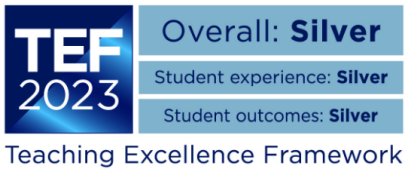
We were awarded a TEF Silver rating overall in 2023, achieving this for both student experience and student outcomes.